
History of
Ice Harvest on Pleasant Lake 1928-1952
Presentation to the Annandale History
Club
November 2, 2005
Aileen (Larson) Lundeen
Louis Larson was born November 5, 1888,
in DalaJarna,
Louis Larson had only a third grade
education in
Grandpa Larson soon bought a little farm
just north of Highway 12 in Cokato. This
had a big nice house that I used to like to visit. The
house is still there, but someone took away the big wrap-around porch I
liked so well.
My mother, Marie Nylen, was born May 25,
1890, in DalaJarna, the same town as my dad, but I'm
told the families never mingled there. My
mother's brother had already come to
I don't know
how Louis and Marie were reacquainted in this country, but they were
married November 15, 1919, and lived on a farm in the Cokato area. They
became friends with Mr. and Mrs. August Ring. August
Ring was in the ice business in Cokato, and we think he asked Louis to
join him. They
worked together harvesting ice from Brooks Lake.
My sister Mardell was born in 1922, and I
was born in 1925. Louis
purchased the ice business in
This is the background history of Louis
Larson as I have been told. I
knew my father as the kind, tender, gentle spirit he was. His
love for his Savior, the Lord Jesus, was uppermost in his life, setting
a wonderful example for us kids. He
ran his business with integrity and always had a smile on his face.
Our house and one large ice house were
located about a block from
Harvesting the ice each winter was quite
a production and required hiring several men.
In the early years, teams of horses were
used to pull sleighs loaded with 400 pound cakes of ice from the lake to
the ice house. Several
farmers in the area were happy to have something for the horses to do in
the winter. I've
been told some of these men were Fred Olson, Ernest Olson, Alvin Olson
and Albert Schultz. (There
may have been others.) The
men who worked for Dad were George Johnson, Earl Johnson, Al Rathje,
Cecil Partridge, Ken Rudolph, Norman Oletzke, Oscar Anderson, Fred
Beckman, Al White, George Houchins, Willie Glaim and Henry Glaim.
Every year Louis would report to the Annandale
Advocate when he had
tested the ice and felt it was safe to drive on. This
would be published in the next issue. The
ice had to be between 30 and 36 inches thick before it was ready to be
cut. This would
be sometime in January. If
there had been a lot of snow, it had to be plowed off so the ice depth
would increase faster.
The first cut was made with a gas driven
motor with a large circular saw attached. This
would cut only part way through. There
was a guide on the ski of the machine to measure the width of the next
row to be cut. There
would be crosscuts, too. The
rest of the cuts had to be done by hand with a long blade saw. A
channel was made to float each 400 pound cake of ice to a ramp that led
up to the platform. A
pulley system was set up with a large ice tong on the end of a rope. Two
or three cakes could be pulled up at a time. The
pulley was activated by one team of horses that pulled at command. The
platform was the height of the sleigh waiting for its load as the ice
came up to the platform. I
guess the horses backed up to get ready for the next cake of ice. There
was a man operating at each of these areas, so it took several to
complete the job. I
don't remember hearing that anyone ever fell
into the water.
There was only one big ice house the
first years. Then
another lean-to addition was added as the demand for ice increased. The
horses pulling the sleigh loaded with many blocks of ice would come from
the lake to the ice house to be unloaded. The
first layer or two was the easiest, but the two or three men in the ice
house had to line the cakes in straight rows. They
had to work fast.
My dad, with the help of John Powers,
made the engine (a big Model T engine) that powered the lift that
brought the 400 pound cakes of ice up to each new level, one cake at a
time. The men
had to move up with each new layer to keep putting the cakes in neat
rows. Sawdust
was used for insulation around the edge and between the rows. I
don't know how many layers went into those
houses, but that final row seemed very high.
My dad would run the lift most of the
time. I don't
remember that there ever was a major breakdown of the equipment. Occasionally,
Louis would be down on the lake to see how things were going. Probably
around 1935, the horses and sleighs were replaced by trucks and
tractors, but I liked the horses and sleighs better.
My dad had a delivery service when it
started to warm up and people needed their ice boxes filled. He
also serviced the pool hall and liquor store. They
kidded him because he never bought anything from them (except maybe to
buy wine for Mom's fruit cake.)
One of his drivers for a rural route was
Al White, and there may have been others.
Louis would be up a 4:30 a.m. to go out
and load up the trucks for the day. He
had built a platform at the opposite end of the ice house, where he
brought out one cake at a time, washed off the sawdust, and cut them
into about 100 pound pieces. He
had a special ax and the right touch to make them come out just right. Inside
the ice houses, high in the ceiling, was another pulley system. There
were two long ropes from there with a large ice tong on the end of one
rope. This tong
would grasp a cake of ice and Dad would pull on the other rope to loosen
the cake and pull it along the ceiling track to the platform.
Mother was part of the ice business, too. They
had a little shed by the side of the garage that Dad would stock with
smaller cakes of ice. There
was a small scale where the ice was weighed. It
was Mother's job to sell ice from this shed to
fishermen, who would come and buy ice to keep their fish cold until they
got home, or for their ice boxes at their cabins. Each
purchase was maybe 25 cents, but it was something (back then, 25 cents
bought a pound of hamburger).
As the gas and electric refrigerators
were becoming popular, the Coolerator was invented. These
looked like the nice, white electric refrigerators, but used ice. Dad's
selling point was that the food stayed fresh longer and never dried out. We
even could make ice cubes with a special ice cube maker. It
looked like an ice cube tray but had a container
across the top to pour in hot water. This
sat on top of the cake of ice and sank down into the ice. A
special ice pick cut the cubes loose. It
was proven that the ice was pure enough to eat, because of aeration and
the freezing. (This
wouldn't pass code today.)
My dad was having a lot of hip pain and
getting tired, so it was time to retire. The
business was sold to Mr. Comstock and again to Mr. Gunderson, maybe
around 1953.
Louis Larson died October 13, 1956. Marie
Larson died January 16, 1971.
Written by Aileen Larson Lundeen
 |
|
|
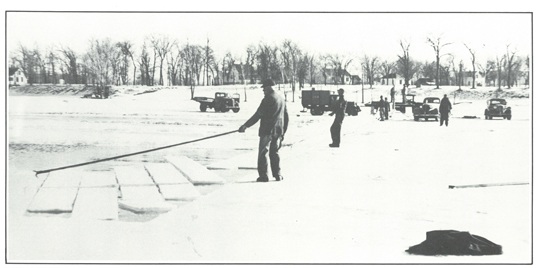
AA, January 28, 1943: Ice man Louis Larson completed his ice harvest on Saturday after taking time out for a few days due ot the cold weather. The ice was 21 inches thick when he started and 28 inches thick when he finished. Mr. Larson estimates that he has put up around 8,000 cakes of ice. There is considerable melting before it is all used. The average weight of the cakes is 500 pounds. Mr Larson said it is the clearest and best ice he has had for quite a number of years. Pass the Lemonade, please!
AA, Jan 8, 1942: Louis Larson, theh local ice man is harvesting ice this week. Mr. Larson reports the ice to be frozen 15 inches deep. On Monday, when the temperature bounded down to a mere 25 degrees below zero they needed to keep their power driven saw in constant motion, in fear it would freeze up.